
Kansas Resident Lookup Coverage
Kansas has no single roll of everyone who lives in the state. Instead, each record answers a narrower question. County appraisers identify titled owners and parcels; VoterView checks a named registrant; court files show a person's role in a case; and vital certificates are issued only to eligible requesters. The table separates those roles so a result does not claim more than its source can show.
| Record | What It Confirms | Where | Access |
|---|---|---|---|
| County appraiser roll | Owner, parcel, situs and sometimes mailing address | County appraiser or GIS office | Public fields vary by county |
| VoterView | Matches a named registrant's record and polling details | Kansas Secretary of State | First name, last name and birth date required |
| District-court case | Case number, parties, events and public filings | Kansas courts portal | Registration; limits and kiosk fallback apply |
| Vital certificate | Birth, death, marriage or divorce event | KDHE Vital Statistics | Confidential; eligibility and $20 fee |
| Deed or probate file | Recorded ownership or estate proceedings | County Register of Deeds or district-court clerk | County coverage, fees and case limits vary |
| Business or license record | Filed entity, agent or professional credential | Kansas Secretary of State or issuing board | Searchable public filing or board record |
| Obituary or cemetery index | Past death, family or community link | Library, archive or cemetery custodian | Historical clue; confirm against its source |
Choose the first record by the fact in hand. A case number belongs in the court portal; a parcel question belongs with the county appraiser; and a certificate request belongs with KDHE or the non-state custodian of an older record. VoterView is for confirming a particular registration, not browsing all residents by name or ZIP. When the question is historical, a library index or obituary can point to a dated lead, but it cannot replace a court, deed, or vital record held by the official custodian. If the search widens from one person to everyone tied to a street, the Kansas street address directory follows that broader address trail.
Kansas Court Searches by Name
The Kansas District Court Public Access Portal covers Odyssey case data across the state's district courts, but a name search takes setup. Smart Search requires account registration and one required starting value: a case or record number, or a name. The official Smart Search guide uses the format Last, First, Middle, Suffix. You can narrow results by county and party type, and advanced filters support other identifiers. A search result is a lead to a case, not proof that the person is the one you seek.
Use the filters only when you have a sound reason to enter them. The guide lists date of birth, KBI number, SO number, booking number, case type, case status, filing date range, and judicial officer. The party selector includes name, business name, nickname, or “Sounds Like”; business-name searching must be selected for an entity. Last-name wildcards need at least three characters before an asterisk, while first-name wildcards need one. Case and citation numbers do not accept wildcards. Submit also requires the reCAPTCHA check.
| Portal and field | Type | Required | Options or format notes |
|---|---|---|---|
| Smart Search: case number or name | Text | One required | Case formats vary; name uses Last, First, Middle, Suffix |
| Smart Search: location | Dropdown | No | All locations or an individual county |
| Smart Search: search type | Dropdown | No | Includes party, business, nickname, attorney, case, citation and judicial officer options |
| Smart Search: search by | Radio or checkbox | No | Party, business, nickname or Sounds Like; select business for an entity |
| Smart Search: DOB from/to | Date pair | No | Additional party criteria |
| Smart Search: KBI, SO or booking number | Text | No | Additional party identifiers |
| Smart Search: case type/status | Dropdowns | No | Case category and status filters; some categories are excluded or limited |
| Smart Search: file date start/end | Date pair | No | Filing-date range |
| Smart Search: judicial officer | Dropdown | No | Judge selection |
| Smart Search: submit and reCAPTCHA | Button / check | Final step | Verify the check before submitting |
| VoterView: first name | Text | Yes | Entered with last name and date of birth |
| VoterView: last name | Text | Yes | Entered with first name and date of birth |
| VoterView: date of birth | Date | Yes | Required disambiguating field |
| VoterView: residential address | Address field | For polling-place search | Address mode returns polling locations, not registrants by ZIP |
| SOS search mode | Tab or mode | Choose one | Business name, Kansas SOS ID, or current resident agent |
| SOS business name | Text | By selected mode | Contains or Starts With; first 200 matches only |
| SOS business ID | Text / numeric | By selected mode | Digits only, no dashes or spaces; not a federal ID number |
| SOS current resident agent | Text | By selected mode | Contains or Starts With; first 200 matches only |
Some case types are excluded or limited, including adoption, juvenile, certain family, mental-health, probate, guardian and converted matters. Public access rules still apply to the case record. A remote search can show a thin result when older documents were not converted, so note which county and filters you used before deciding that nothing exists.
Check a Kansas Resident's Identity
A shared name is common across a state with 105 counties. Tighten the search with a county, middle name or initial, relevant date span, and an identifier that is both available and appropriate to use. Keep spelling variants separate in your notes. The court portal can offer a Sounds Like search, but a phonetic match can widen the results and should be followed by individual case review.
For a court result, preserve the fields the public record actually shows. The official Smart Search guide describes a result trail built from case number, location, case type, parties, events or disposition, and document availability. Compare the county, filing date and party role across any candidate records. A court appearance only confirms a role in that case. A parcel record may name an owner or taxpayer rather than a resident, and an SOS filing may name an agent or principal office rather than a home.
Use a confidence label while comparing results: directly indexed, address-associated, historical, or inferred. “Address-associated” is not the same as living at an address today. A dated obituary can identify a family link; a deed can identify a transfer; neither should be converted into a claim about a living person's current location.
A useful sample inventory to preserve is the case number, county, case type, parties, file date, events or disposition, and document-access status. Record only what the portal shows. If an index entry names a party but the converted document is unavailable online, label the missing image and ask the court about its kiosk rather than treating the listing as a complete file.
- Case number and county or location
- Case type and filing date
- Party names and listed roles
- Visible docket events or disposition
- Document image status and kiosk or clerk follow-up
Note: A Smart Search hit remains a case-specific entry; county, dates and party role still need to align before you connect it to a person.
Verifying a Kansas Resident
When you have a name plus a plausible county or address clue, work from the strongest record to the next. Keep each record's date and purpose attached to the result. The process below checks a public name trail without treating a parcel, case, or organizational filing as a live resident list.
- Write down the name, county, known date range and the source of the starting clue. Do not begin with a common name alone.
- For an address lead, search the relevant county appraiser or GIS record by the known address or owner name when the public tool allows it. Copy the parcel ID, legal description, owner name, situs address and any separate mailing address, then treat the result as an owner clue rather than occupancy proof.
- Use the court portal for a case question. Search the name and variants, then narrow by county, date, case type or another permitted field.
- Compare party role, case number and dates across candidate records. For older converted documents, ask the district court about its public kiosk.
- Use a business or license record only to check an affiliation or credential. Confirm the entity name, board, status and filing date in the official source.
- For a vital event, check eligibility with KDHE or the proper earlier custodian before submitting an application or fee.
- Keep the source date and confidence label with each fact. If a source is wrong, ask that custodian about its correction process.
- Docket
- The court's ordered list of filings and events for a case. It does not contain every document or explain a result by itself.
- Index vs. image
- An index helps locate a record and may show brief fields. An image is the scanned document, when the custodian makes it available.
- Certified copy
- A copy the custodian certifies as an official copy. A printout or index entry is not automatically certified.
- Legal description
- The parcel description in the land record, such as a lot and block or a section-based description, used to identify land beyond a street label.
Voter Records for Kansas Residents
VoterView is a confirmation form for one named person's registration. It requires first name, last name and date of birth; the page says all three fields must be entered. A successful result can confirm the registrant's address, party association, mail-ballot status, polling place and districts. A no-match message means that the submitted values did not produce a match in that search. It does not establish that a person has never registered or that another public record is absent.
The same site has a separate polling-place search. It asks for a residential address and returns polling locations when it can match the address. Neither mode is a ZIP-wide or street-wide voter directory. Kansas law limits inspection and use of registration lists, and the state describes political or election use as the permitted context for copies. K.S.A. 25-2320 and K.S.A. 45-230 govern access and use; do not turn a single-person confirmation into a list of neighbors.
For an authorized record or election-office question, identify the county election officer through the Secretary of State's county contacts and ask what record and current request procedure apply. A county may hold poll books, older registration ledgers or historical material that is not in the web form. Ballot choices are not public, and a registration result is not evidence of how someone voted.
Kansas Vital Record Eligibility
KDHE's Office of Vital Statistics holds Kansas birth, stillbirth, death, marriage and divorce certificates. They are confidential records, not a public name index. Under K.S.A. 65-2422d, an applicant must qualify as the named person, immediate family, legal representative, or someone with a direct interest in establishing personal or property rights. The office can require proof of identity and eligibility. There is no blanket rule that makes current Kansas certificates open after a generic number of years.
The application forms identify their covered records: birth and death from July 1, 1911; marriage registration began in 1913; and divorce certificates from July 1, 1951. The listed fee is $20 for each certified copy, with a five-year search span on the inspected forms. Each application asks for event and identity details, and the birth application requires a copy of current legal photo ID. A certificate request is different from a request to inspect a court case or a family-history index.
For genealogy, KDHE's genealogy guidance says pre-1940 requests may be made by contacting Vital Statistics; post-1940 requests require immediate family. The exact historical exception applies to qualifying birth, death or marriage records created before July 1, 1911 and not held by the state. Those records may be held by a county clerk, church, library, historical society or other non-state custodian. Ask where the original record is held instead of assuming KDHE has an open index. A divorce certificate also differs from a district-court divorce file, which may have its own access limits.
Note: Eligibility controls certificate access, while the pre-July 1911 exception applies only to qualifying records held outside state custody.
Kansas Business and License Clues
A business record can help confirm that a name is linked to a filed organization. The Kansas Secretary of State's Business Entity Search has separate modes for business name, Kansas SOS ID and current resident agent. It offers Contains or Starts With searches for names, and its results stop at the first 200 matches. A missing name may mean there is no Kansas filing, or that the activity is a sole proprietorship, assumed name or other filing outside this search.
Use the official search modes as shown, and record the entity name and SOS ID before opening a filing. The index may show a registered agent or principal office. Those are organization fields and do not prove the person lives at the listed address. The included image shows the official search tabs and their modes.
Professional credentials are spread across separate Kansas boards. The Kansas Board of Healing Arts profile search requires at least three letters; nursing and other boards use their own forms and result limits. Capture the issuing board, credential type, number and status. A license verifies only what that board reports. For a city license or assumed-name filing, ask the proper city or county custodian, because Kansas has no single central professional or local-license search.
See the Secretary of State's business search for its current tabs and field options.
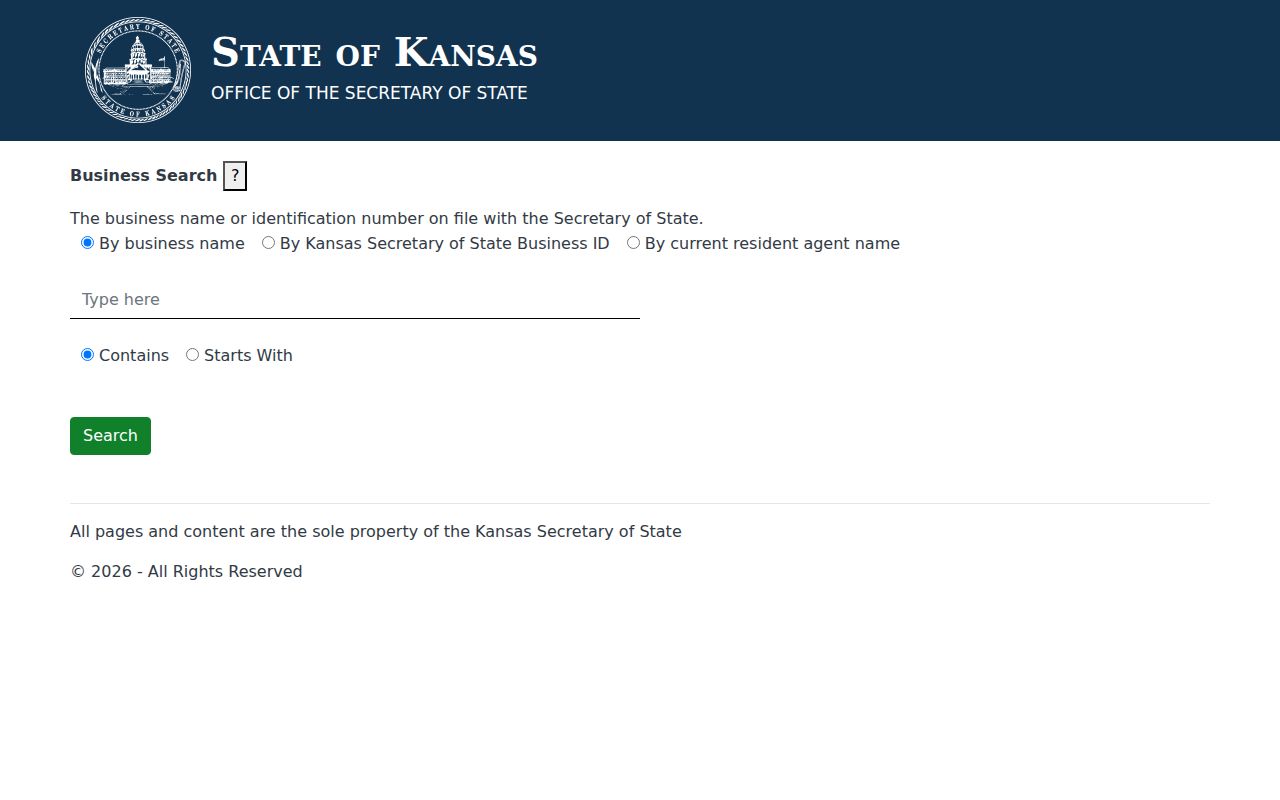
Use a business result as an affiliation clue, then verify the filed report or credential with its custodian.
Probate and Kansas Archive Leads
When the question concerns an heir or a deceased relative, probate files can connect an estate name, executor, heirs and filings. The Kansas district-court portal may show public docket information, but sealed, medical, juvenile and other protected material is not open through a name search. The clerk is the fallback for a case number, archived record, or copy procedure. For an heir question, compare the probate record with a dated obituary, cemetery entry or deed transfer rather than relying on a single name match.
Historical work has several Kansas starting points. The Kansas Historical Society State Archives holds statewide government records, manuscripts, photographs, newspapers, directories and census materials. The Topeka Room and Baker Genealogy Center at Topeka and Shawnee County Public Library keep local directories, maps, vertical files, obituaries and newspapers. Its obituary index has more than 17,000 entries, a useful lead for a family-history search. Wichita Public Library reports a genealogy collection of more than 25,000 volumes, along with databases, microfilm and research service. These collections are not a statewide directory of living people; they help trace dated family or community links. For a closer look at those holdings, use the Kansas city directory collections page.
A former classmate may appear in a yearbook or university collection, but alumni directories can require membership or other authorization. For an adoption or birth-parent question, KDHE's rules and Kansas adoption registry or confidential-intermediary route are the relevant official path. The research did not locate a definitive statewide program page, so confirm the current process with KDHE or the court before making a request. A library catalog or obituary index may find a lead, but not replace the official record.
Requesting Kansas Records Under KORA
When a web form does not answer the question, ask the office that keeps the record. The Kansas Open Records Act (KORA), K.S.A. 45-215 through 45-223, lets any person request existing public records, subject to exceptions and lawful fees. Under K.S.A. 45-218(d), an agency must act as soon as possible and no later than the end of the third business day after receiving a request. That deadline is a response rule, not a promise that every record will be released by then.
Make the request narrow. Give the person's name or organization, county, record series, date span and case or instrument number if known. Say whether you seek inspection or a copy. The office may charge actual copy or staff costs under its schedule, and K.S.A. 45-221 allows records or fields to be withheld under specific exceptions. A public-records request cannot open a confidential KDHE certificate or compel an office to create a new report.
For land records, identify the county first. The Kansas Register of Deeds Association contact list lists all 105 county registers and their contacts, but there is no single statewide deed index or common online cutoff. Ask the county Register of Deeds about its online search depth, counter index, deed books, microfilm and copy fees. For district-court records, use the portal first, then ask the clerk whether a courthouse kiosk or archived-file request can reach converted pre-Odyssey documents. A municipal case stays with the city court, whose search fields vary by city.
Note: KORA requests work best when they name an existing record, its custodian, a county, a useful date range and a clear record type.
Privacy Limits on a Kansas Resident Lookup
Public access has boundaries. KORA permits privacy and law-enforcement exceptions, and record custodians decide whether an address or other field must be redacted. Utility accounts and motor-vehicle address data are not general resident rolls. Court documents may be sealed or restricted, and vital certificates remain confidential under their own statute. If a record is wrong, contact the office that created it and ask how to request correction; a copied result elsewhere will not fix the source record.
Kansas Safe at Home gives qualifying survivors of domestic violence, sexual assault, stalking or human trafficking a substitute address and free first-class mail forwarding. The Attorney General's Victim Services Division administers the program under K.S.A. 75-451 through 75-458. It can support voter registration and state or local records without exposing a participant's physical location. Do not try to reconstruct a protected address from parcel, voter, court, cemetery or directory clues.
Commercial directory opt-outs are a separate process from a request to a Kansas custodian. Use the site's own privacy form, confirm the profile, send only the minimum proof it asks for, save the confirmation and check again later because new filings can repopulate a profile. That request does not remove the source record held by a county or state office.
Kansas law also restricts the sale or use of public-record name-and-address lists for offers, and voter-list access has its own limitations. Personal, family-history, civic and correction questions should remain narrow and lawful. Stop if a record is protected or the request would expose a person who has chosen a confidentiality process.
Lawful use. Use Kansas records for personal, family-history, civic or records-correction questions. Do not use a result to stalk, threaten, harass or expose another person.