
Start a Search for Kansas Residents
The best first record depends on what is already known. A full name may lead to a state portal; a street address belongs first to a county appraiser or GIS office; an older household may only appear in a library book. Kansas has no single current resident roll. Its records are split among 105 counties, state agencies, city offices, and local-history collections. A record can point toward a person, but each custodian describes only the work that office performed.
Use a short path and keep the source date with every result. An owner name means legal title or tax responsibility, not proof that the person lives at the parcel. A voter match is a named registration check, not a street list. A printed directory captures a past edition, while court and vital records can have access limits. These distinctions help a Kansas residents directory search stay useful for family history, a property question, or a records correction.
- Identify the county from the address or event. Use the Kansas Register of Deeds Association list to find the right county office.
- For a parcel, check its county appraiser card for the owner, situs address, mailing address, and legal description.
- Use a named state search only for the record it covers. VoterView checks a registrant; the court portal searches eligible district-court cases.
- For an older household, search the town and year in a library or archive directory, then compare the entry with census, deed, or newspaper records.
- When a public record is not online, ask the named custodian for its counter, mail, microfilm, or KORA request process.
Where Kansas Keeps Resident Records
Kansas uses state custodians for vital certificates, elections, courts, business filings, and the state archive, but property and deed records remain local. Every county has a Register of Deeds, and the county appraiser is the first stop for a parcel card. The Kansas Register of Deeds Association publishes names, phone numbers, and email contacts for all 105 offices. Search that list by county before you look for a deed index; vendors, online depth, fees, and older books differ.
The state offices below are useful for statewide records and historical research. A local request still goes to the office that holds the item. The Kansas Historical Society can guide researchers to state archival holdings, while the library, courthouse terminal, or county counter may hold a local volume that never reached the web.
Kansas State Archives
Kansas Historical Society, Topeka
Directories, census microfilm, newspapers, manuscripts, and state records
KDHE Vital Statistics
1000 SW Jackson, Suite 120
Topeka, KS 66612-2221
785-296-1400
Kansas Elections
Secretary of State VoterView
County election officers hold local election records and voter-file request procedures
Note: The statewide contact map identifies every county register, but it does not search Kansas deeds.
Kansas Residents in County Deed Indexes
A deed index names parties to recorded instruments, not everyone who lived at an address. Start with the county parcel card, note the owner's legal name and the land description, then search that name in the Register of Deeds index. The county association list is a statewide routing tool, not a statewide deed search. Kansas has no one public deed portal and no universal online start year. A county may offer an online index and images; another may rely on the counter, written copy requests, old deed books, or microfilm.
For a past owner, search the current owner as grantee, the party receiving the deed. Read the listed grantor, or seller, and search that person as grantee to move to an earlier transfer. A corporation, trust, estate, or attorney may appear instead of a household member. Instrument images often give the legal description and prior-document reference needed to follow the same land when a street number changes. The full address-by-address process belongs on the Kansas street directory page.
- Grantor
- The person or entity transferring an interest.
- Grantee
- The person or entity receiving an interest.
- Legal description
- The lot, block, subdivision, or land terms used to identify the parcel in a deed.
Kansas VoterView Checks a Named Registrant
VoterView is a confirmation form, not a browsable Kansas residents directory. It asks for a first name, last name, and date of birth together. A match can show the registration address, party association, mail-ballot status, polling place, and districts. A polling-place tool separately takes a residential address. If the form returns no result, check spelling and the date entered, then contact the county election officer for the official correction path.
Kansas voter lists have limits on copying and use. K.S.A. 25-2320 and K.S.A. 45-230 govern inspection or copies and prohibit certain commercial uses of name-and-address lists. The state does not expose a downloadable public list through VoterView. A complete request, if available for a lawful purpose, goes to the county election officer with the current certification and delivery rules. Ballot choices are not part of the public registration check.
| VoterView field | Entry | What the form does |
|---|---|---|
| First name | Text, required | Used with the last name and date of birth. |
| Last name | Text, required | Narrows the match to a named registrant. |
| Date of birth | Date, required | Disambiguates the registration record. |
| Residential address | Address search | Finds polling-place information, not a list of residents. |
Safe at Home participants may use a substitute address in voter registration. Do not treat a missing online match as proof that someone has no Kansas address or record.
Kansas Property Cards Separate Two Addresses
A county appraiser card connects a parcel to a titled owner or taxpayer. It may show the situs address, owner mailing address, parcel ID, legal description, appraisal and tax details. Those fields can point to a person or entity, but they do not list every household member. A homestead flag can be consistent with owner occupancy; it still does not prove who is home today. Keep the parcel year and source with the result.
Johnson County's AIMS map documents searches by owner, address, property ID, ZIP, city, intersection, township-range-section, and AIMS map number. Its property panel can show owner names, mailing lines, tax and appraisal information, acres, year built, class, neighborhood code, KUPN, taxing unit, and zoning. Sedgwick County's Mobile Land Records accepts an address, parcel ID, intersection, map click, or current device location. Its parcel boundaries are tax maps, not a survey.
Sedgwick County's appraiser page is a practical example of a county property-search entry point. Its image shows where the county starts the public search; the result card and its fields depend on the county system.
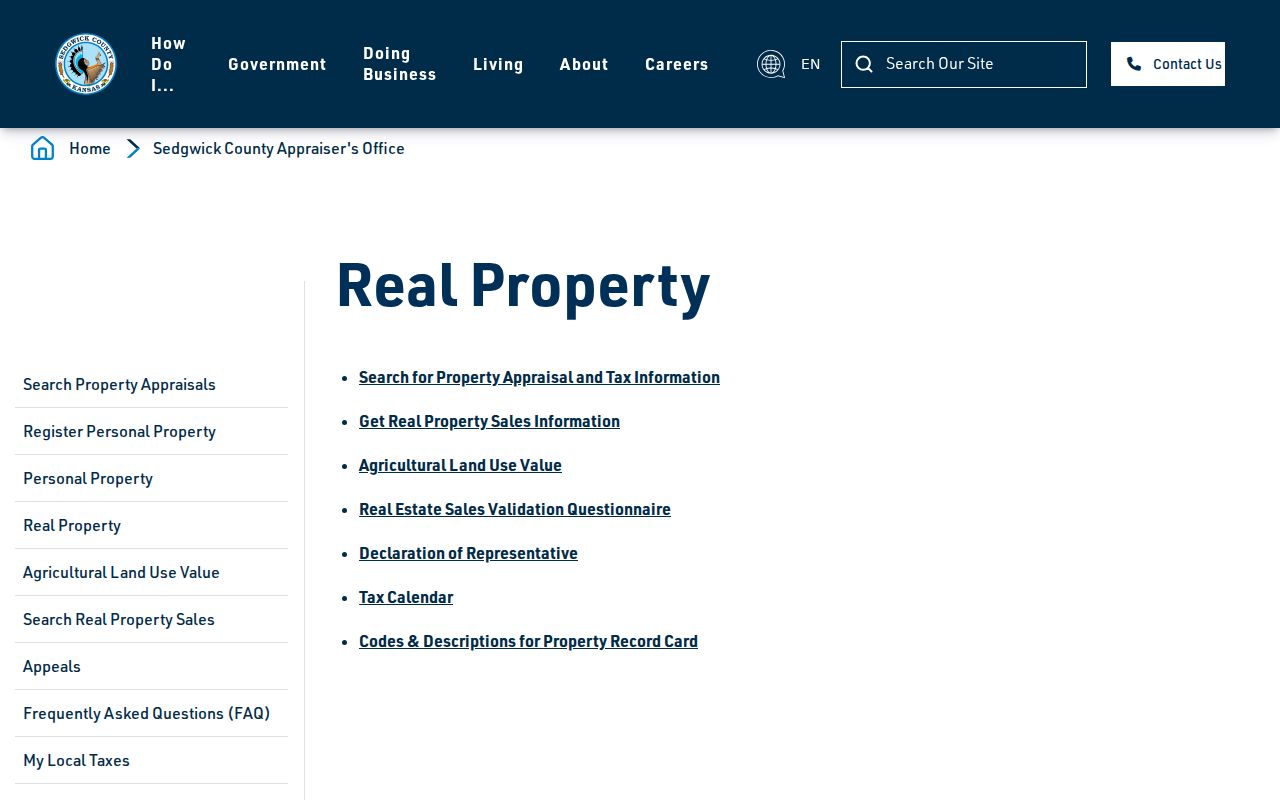
Use the parcel number and legal description to bridge the appraiser to a deed or plat. For a walk through a whole street, use the Kansas by-street records path rather than treating a single property card as a resident list.
Kansas Court Search Has a Kiosk Fallback
The Kansas district-court portal covers public Odyssey case data across the state's counties. Smart Search requires registration and a case number or name; advanced controls can narrow by location, party-name style, date of birth, KBI or booking number, case type, status, filing-date range, and judicial officer. Some sensitive case classes do not appear. A case search finds a court record, not a person’s current home address, and a same-name result must be checked by county and case details.
The official court guide says documents from older converted systems may not display online even when a case record does. Each district court maintains a public terminal, so a courthouse kiosk is the next stop for those files. A clerk can explain archived-case retrieval and copy procedures. A narrow request under the court's process or KORA should name an existing docket or document and a date range; it cannot compel a new report to be made.
| Smart Search control | Type | Required | Use or format |
|---|---|---|---|
| Record/case number or name | Text | Yes, one | Case-number patterns vary; a name can include last, first, middle, and suffix. |
| Location | Dropdown | No | All locations or one county. |
| Search type | Dropdown | No | Party, case, citation, attorney, business, nickname, judicial officer, and other listed modes. |
| Search by | Choice controls | No | Party, business, nickname, or sounds-like search. |
| DOB from/to | Date range | No | Additional party filter. |
| KBI, SO, booking number | Text | No | Optional party identifiers. |
| Case type and status | Dropdowns | No | Filter by category or case status; some classes are excluded. |
| File date start/end | Date range | No | Narrows the filing period. |
| Judicial officer | Dropdown | No | Limits results to a judge. |
| Submit and reCAPTCHA | Button and check | Final | Complete the verification before submitting. |
Note: Save the county, search mode, date, result number, case number, and document status so a second search can be repeated.
Kansas Vital Records Require Eligibility
KDHE does not offer a public birth, death, marriage, or divorce index. These certificates are confidential. An applicant must be the named person, immediate family, a legal representative, or show a direct interest under K.S.A. 65-2422d. The state forms list a $20 certified-copy fee and request identification and relationship details. Birth and death forms begin July 1, 1911; statewide marriage registration began in 1913; divorce certificates begin July 1, 1951. Those dates describe the state forms, not every local record that may survive.
There is no simple rule that an older KDHE certificate becomes an open index. The statute does make qualifying birth, death, or marriage records created before July 1, 1911 and held outside state custody open. For genealogy, ask the Kansas Historical Society, county clerk, church archive, or local library about a ledger or index. KDHE's guidance says pre-1940 genealogy requests may be made by contacting the office; post-1940 requests require an immediate family member. The forms and office details sit on the KDHE Vital Statistics page.
Note: A divorce certificate and a district-court divorce file are separate records held by different custodians.
Current Kansas Resident Records
Modern Kansas records are split by purpose and custodian. An appraiser ties a name to a parcel, a court portal ties a party to a case, and VoterView checks an individual registration. None is a full list of who lives in Kansas. Before using a result, read the date, county, field label, and access note. A property owner can have a different mailing address; an entity may own the land; and several records may concern different people with the same name.
| Kansas record path | What it can show | Custodian | Access route |
|---|---|---|---|
| Property card and tax roll | Owner or taxpayer, parcel, situs and mailing details | County appraiser or treasurer | County portal, counter, or copy request |
| Registration check | A named voter's status, address confirmation, party, and polling place | Kansas Secretary of State or county election officer | VoterView; extracts have use limits |
| Recorded instrument index | Deed parties, instrument type, date, and legal description | County Register of Deeds | County portal, counter, books, microfilm, request |
| District-court case | Public party, case number, event, status, and available filings | Kansas Judicial Branch and district clerk | Web portal, courthouse kiosk, clerk request |
| Historical directory | Dated name, address, and sometimes occupation or household notes | Libraries and Kansas Historical Society | Reading room, microfilm, online databases, interlibrary loan |
For one person, compare sources that ask different questions instead of counting each result as a match. Separate a registration, court-party record, property-owner entry, and historical listing by date and custodian.
KORA Requests for Kansas Resident Records
The Kansas Open Records Act, K.S.A. 45-215 through 45-223, lets any person ask a public agency to inspect an existing non-exempt record. Under K.S.A. 45-218(d), the agency must act as soon as possible and no later than the end of the third business day. It may provide access, state a fee or explain a delay or denial. K.S.A. 45-219 allows reasonable charges tied to actual costs. KORA does not require an office to create a new report or answer a broad question.
Name the likely custodian and describe the record with the details already known: county, office, record type, date range, person or parcel, and preferred format. Ask for a segregable public part if another field may be closed. If the item is a deed, start with the Register of Deeds; if it is a city permit, contact the city planning or code office; if it is a court file, contact the district clerk. Each Kansas agency publishes its own request procedure and fee practice.
The Kansas Attorney General's KORA guidance explains the request path and common exceptions. County archives, public terminals, library microfilm, and interlibrary loan remain useful when an older item is not in a web index.
Kansas Residents Cross ZIP and City Lines
A postal city, ZIP code, county parcel, school district, and municipal line may point to different offices. Kansas does not have one statewide parcel lookup to settle every address. Johnson County's AIMS documents ZIP searches; Wichita GIS layers include ZIP, city limits, annexations, subdivisions, schools, and neighborhood associations. Sedgwick's mapping service connects street addresses to tax parcels. Confirm the current delivery city with USPS, then use the parcel's county and the relevant city planning office for land and permit questions.
Census ZIP Code Tabulation Areas (ZCTAs) are generalized areas built from 2020 Census blocks. They do not equal current USPS delivery routes, and they may omit PO-box-only, unique, noncontiguous, or otherwise special ZIPs. The Census Gazetteer offers a reproducible statewide geography file, but an exact mailing address should still be checked through USPS. Do not treat a postal city label as proof that an address sits within city limits.
Note: Use a legal description or parcel number to follow land when a postal name or street label changes.
Historical Kansas Resident Directories
The Kansas Historical Society lists city, county, farm, business, and telephone directories from 1859 forward in its finding aids. Its State Gazetteer and Business Directory volumes span 1878 to 1912. The Topeka Room describes hardbound city directories from 1870 to the present and supports them with house files, maps, newspapers, obituaries, and census tools. Wichita's Advanced Learning Library genealogy room has more than 25,000 volumes, microfilm equipment, databases, and a limited research-by-mail service.
A directory is a dated publication. It may name a householder, street, occupation, spouse, or owner/renter mark, depending on the edition. It does not list every resident, and missing years can reflect a skipped publication or a changed city boundary rather than a move. The full shelf-by-shelf account belongs on the Kansas city directories page. For a particular address, the library or archive can check its catalog, microfilm, local subscription databases, or interlibrary-loan options.
Kansas's historical record trail also includes state census schedules from 1855 to 1925, federal census films, newspapers, cemetery indexes, plat books, and Sanborn maps. Pair a directory year with the nearest census and preserve the original street spelling before trying to reconcile it with a modern address.
Kansas Resident Privacy and Safe at Home
Not every name or address in an agency file is open. KORA has exceptions, and a custodian may redact a protected field while releasing the rest. Kansas Safe at Home gives eligible survivors of domestic violence, sexual assault, stalking, or human trafficking a substitute address and free first-class mail forwarding. The Attorney General's Victim Services Division administers the program under K.S.A. 75-451 through 75-458. It is a confidentiality tool, not a guarantee of safety or witness protection.
For other record questions, ask the original custodian whether a statute or protected-person flag applies. A commercial data opt-out handles a separate copy held by that company; it does not remove a deed, court docket, or tax record from its source. Voter lists carry their own rules, DMV addresses are restricted, and utility or delivery records are not public resident rolls. Personal research should not turn into repeated contact, threats, or attempts to expose a protected address.
An official Kansas office can confirm what its dated record says, subject to access rules. A commercial people-search product may compile old public and broker data, mix people with similar names, or retain information after the source changes. Treat it as an unverified lead, then check the original custodian. A company opt-out applies to that company's copy and does not remove a court file or deed.