
Kansas Historical Directory Collections
Kansas city directory holdings are spread across statewide archives and local library shelves. The Kansas Historical Society (KSHS) has city and county finding aids from across Kansas, with publishers that vary by town and year. Topeka and Wichita have separate local history collections, while the Library of Congress (LOC) lists a specific Lawrence, Kansas criss-cross run. The table distinguishes known Kansas holdings from places where the inspected guide does not publish a complete year-by-year inventory.
| Collection | Years and publishers | Where held | Access route |
|---|---|---|---|
| Kansas city and county directories | 1859 to date in statewide finding aids; Polk and local commercial publishers | KSHS State Archives and Library, Topeka, Kansas | Kansas directories database and ATLAS; research room, microfilm, interlibrary loan; some Ancestry digitization through 1963 |
| Kansas State Gazetteer and Business Directories | 1878–1912 | KSHS and Kansas Memory | Free digital items where digitized; listings can cover several towns and businesses |
| Topeka bound volumes | Hardbound 1870 to present; a library resource sheet lists Polk's Topeka City Directory 1926–2010 | Topeka Room, Topeka & Shawnee County Public Library, Kansas | Physical shelf and HeritageQuest Online for Kansas local history research |
| Wichita, Kansas local-history collection | Wichita runs are held, but the inspected page does not publish a complete year list | Burns Historical Research Pavilion, Advanced Learning Library | Onsite, microfilm, digital archive, and limited email or mail research |
| Lawrence, Kansas & vicinity criss-cross | 1978–1996 in the LOC guide | Library of Congress, John Adams Building | Specify type, place, state, and years on a reading-room paper slip |
| Kansas telephone directories | Town and year runs vary | KSHS, local libraries, and LOC | Print, microfilm, onsite access, or interlibrary loan where available |
A statewide finding aid does not mean that each Kansas town has an unbroken annual set. A Kansas publisher, coverage area, and publication year can change, and Wichita's complete local run was not stated in the inspected guide. Treat the earliest catalog entry, first surviving Kansas volume, digitized year, and last known printed year as separate facts rather than filling an unlisted year by assumption.
The Kansas Historical Society directory holdings page explains its directory and telephone collections, microfilm, interlibrary loan, and database access.
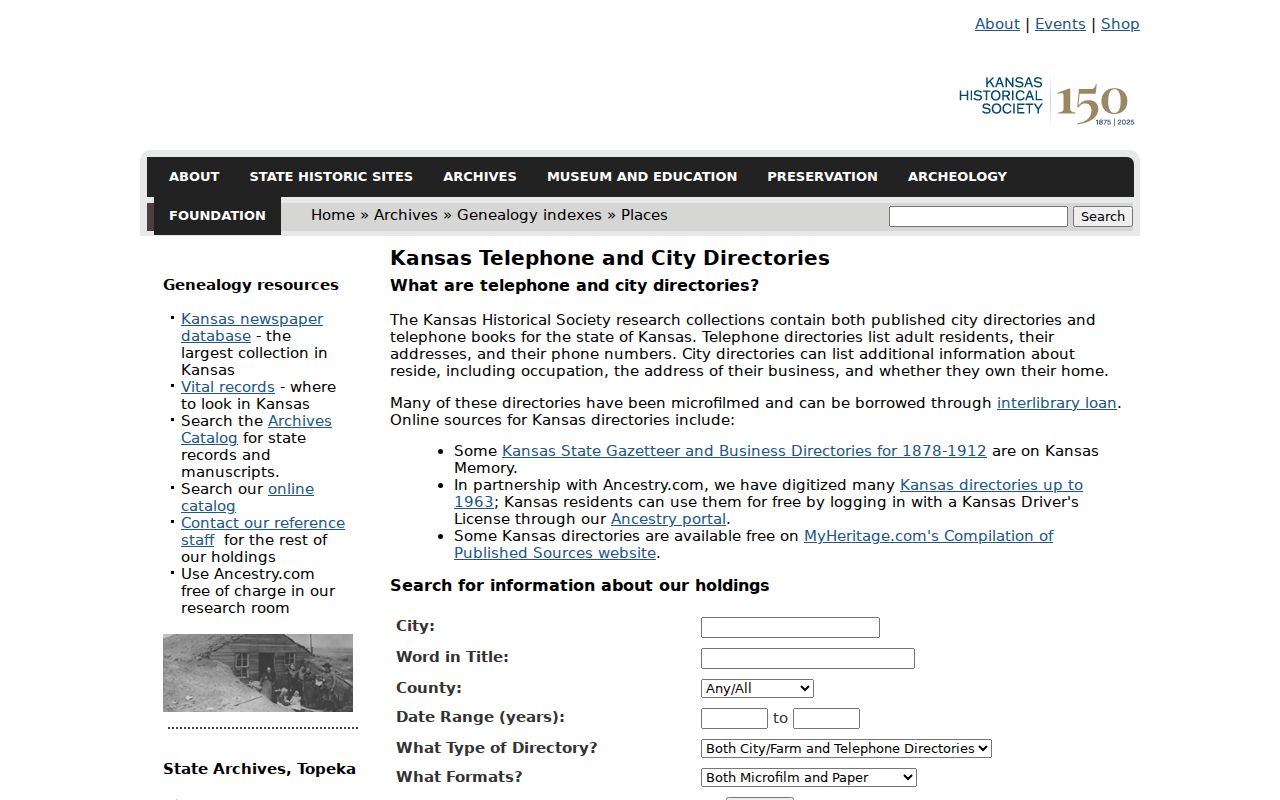
Use the page as a starting point, then ask reference staff about the particular city and year if a catalog result does not expose the volume itself.
Kansas Topeka Directory Holdings
The Topeka Room at Topeka & Shawnee County Public Library describes hardbound directory volumes from 1870 to the present. A library resource sheet lists Polk's Topeka edition for 1926–2010, while HeritageQuest Online adds a searchable route. The Room also holds vertical files on people, businesses, schools, and neighborhoods, plus census, obituary, newspaper, tax, probate, plat, and insurance-map material that can help test a name or address found in a directory. For Kansas local-history work, visitors can browse the second-floor collection and use computers, photocopiers, and microfilm; the library also offers a local research request path and an obituary index with more than 17,000 entries. These are useful cross-checks when a Kansas name or street entry needs a date or nearby source.
The Topeka library's local history visit page describes the room and its directory shelf.
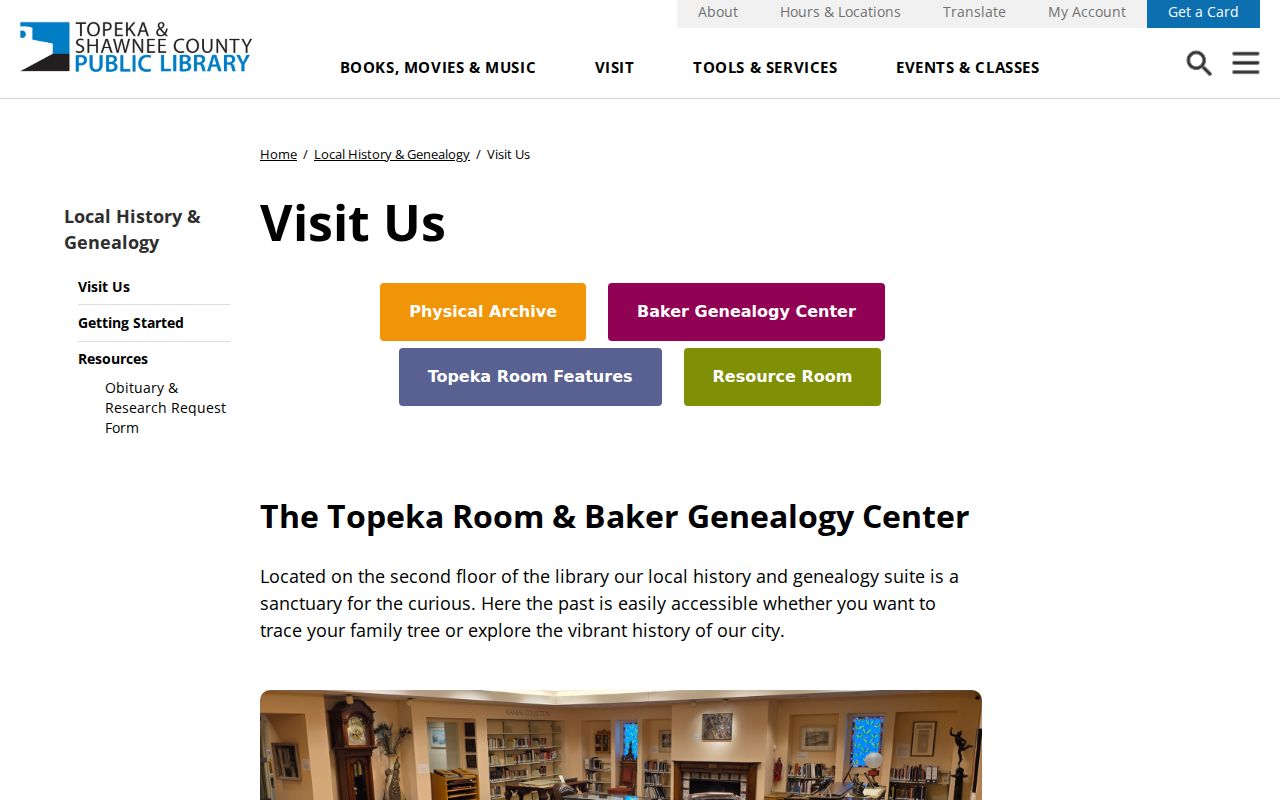
Use the library's name and street searches together when available. A Kansas directory may say where an entry appeared in a particular year; the related Topeka house file, newspaper, or map can help explain a move or address change. A Kansas address is best read alongside those local sources.
Kansas Wichita Directory Research
Wichita Public Library's Burns Historical Research Pavilion reports more than 25,000 genealogy volumes, alongside census microfilm and Soundex, probate and land indexes, obituaries, local newspapers, church and cemetery indexes, and digital archives. For Kansas researchers working in Wichita, the inspected guide confirms city directories and microfilm but does not state a complete year run, so ask staff which volume covers the period in question instead of assuming every Kansas year survives.
The Wichita Public Library genealogy page sets out its Kansas local history and research services.

The Pavilion can scan Kansas microfilm to JPG or PDF. The library lists copies at $0.25 and limited email or mail research at $5 per half-hour, with a one-hour limit. These are the stated terms for this Wichita service; use its current page to confirm how to submit a Kansas research request.
Kansas Lawrence Criss-Cross Directory
The Library of Congress inventory identifies a Lawrence and vicinity reverse directory run from 1978 through 1996, along with a Kansas northwest regional volume for 1994/95. This is a specific collection listing, not evidence that every Kansas town has a criss-cross book for those years. A reverse directory starts with a street address and can lead to a name, while an alphabetical section may then add the household or occupation notation.
LOC says requests for uncataloged address directories require the directory type, location and state, and specific years. The request is submitted on a paper slip in the John Adams Building reading room. For a Kansas reverse listing, this means an in-person request may be needed even when a Kansas catalog guide points to the collection. Local libraries or HeritageQuest may have other reverse runs, but check each Kansas local catalog rather than extending Lawrence dates to another city.
Kansas Historical Society Directories
KSHS offers several ways into its statewide directory holdings. Its directory database and ATLAS are discovery tools for Kansas records; a title that is not visible online may still be found through reference staff. The State Archives and Library in Topeka provides a Kansas research room and microfilm, and some films can be borrowed through interlibrary loan. The Society also reports digitized directories through Ancestry to 1963, with Kansas residents able to use its arrangement by signing in with a Kansas driver's license. Kansas access depends on the particular title and year.
Local libraries may offer HeritageQuest or Ancestry Library Edition inside the building. The source of access matters: an at-home society arrangement, an in-library database, a microfilm reel, and an original volume do not cover the same years. Before planning a trip, check the catalog and ask whether the volume is onsite, on film, digitized, or held at another location.
Reading Kansas Directory Entries
The inspected collection guides did not expose a scanned Kansas directory page, so the fields below describe what the source inventory says to look for, not a transcription of one actual entry. The Kansas publisher and year determine which details appear in that Kansas edition. Preserve the wording on the Kansas page and check the volume's own index and abbreviation key before reading a mark as a fact.
| Name line | Surname and given name or initials; a spouse may appear in parentheses |
|---|---|
| Address | House number and printed street form, sometimes paired with a street section |
| Occupation or business | May include an occupation, business address, or employer wording, depending on the year |
| Household notation | A spouse or “wid” notation may appear; wording and use vary by publisher |
| Owner or renter mark | Some volumes use a mark; consult that edition's abbreviation key before interpreting it |
| Telephone entry | May appear in a telephone volume, apart from the household directory |
- Criss-cross section
- A reverse directory section arranged by street address, where that edition includes one.
- Householder index
- An index that points from a household name to its entry; labels differ across editions.
- Abbreviation key
- The volume's own guide to shortened words and symbols; check it before expanding a mark.
Kansas House-History Directories
Topeka has a useful Kansas address-first research path. The library directs visitors to search its index under “HOUSES” and the street address for clippings or photographs. Its guide explains that older listings can show where a person lived and for how long, while Kansas Sanborn maps can locate a building by block and number. Put those sources beside the directory year, not in place of it: the map can show a Kansas building footprint, but it does not name every person who lived inside.
The Topeka library's local-history resource guide connects Kansas house files with directories, Sanborn maps, newspapers, and its obituary index. For an older Kansas house, compare the address with the street section, house file, map, and newspaper date. A change in street number or municipal boundary can explain why a later directory no longer shows the same form of the address.
Kansas Directory Year Timeline
The known dates below describe different kinds of collection evidence. Some are printed holdings, some are finding aids, and others are a specific reverse-directory run. Keep those distinctions when you cite a result: a statewide catalog date is not proof that a local volume has been digitized.
| Date or span | Kansas directory milestone | How to use it |
|---|---|---|
| 1859 to date | KSHS statewide Kansas city, county, farm, business, and telephone directory finding aids | Search the specific Kansas town and ask about the physical or film location |
| 1870 to present | Topeka, Kansas Room hardbound volumes | Trace Topeka addresses and names in the local shelf |
| 1878–1912 | Kansas State Gazetteer and Business Directories | Use digitized items for business and multi-town context |
| Through 1963 | Some KSHS directory holdings digitized through Ancestry | Check the year and Kansas resident access route |
| 1978–1996 | LOC Lawrence, Kansas & vicinity criss-cross listing | Address-first clue for the named Kansas place and years |
These spans do not establish annual continuity for every Kansas city or town. Where a Kansas year is absent, check the catalog, local reference staff, and nearby editions before treating the interval as a break in a family's history.
Kansas Directory Year Gaps
A person missing from one Kansas directory may have moved, used another spelling, fallen outside a Kansas publisher's coverage, or gone unlisted. A Kansas town may also have changed boundaries, and the next volume may be missing or unreadable. Search the same Kansas year in both the alphabetical and street sections; OCR can drop punctuation and abbreviations, while reverse pages may spell a street differently from the name index.
Compare nearby house numbers, a Kansas plat or Sanborn sheet, city-limit or annexation maps, and a newspaper notice before deciding that an address vanished. If a Kansas family appears in one edition and not the next, use census, obituary, probate, deed, cemetery, or local paper records to test possible explanations. Preserve the original Kansas spelling and mark the result as “not found in this source” rather than turning one missing entry into a conclusion.
Trace a Kansas Household
Use a name and an approximate place to build a dated sequence, then move from the directory into independent sources. Kansas statewide and local runs overlap unevenly, so work from the exact year on the page rather than assuming that each Kansas town issued a volume annually. A Kansas census or newspaper may help bridge a long interval, while an address and map can help distinguish two people with the same name.
- Choose a directory near the target year and find the name in the alphabetical section. Record the printed name, street form, address, and any household notation.
- Check the same year in the reverse or street section, if that edition has one, to see how the address is indexed.
- Repeat in the available next editions and note each change without filling in years that are not held.
- Compare the entries with the nearest federal census, available through 1950 under the 72-year rule, or a Kansas state census schedule from the years held for that county.
- Check maps, newspapers, deeds, probate, obituaries, and cemetery records for evidence that can explain a move, family change, or end of the published trail.
Kansas state census schedules run from 1855 to 1925 in the cited holdings, but the exact Kansas county and year still need checking. A directory name or address does not prove a legal relationship or continuous residence; treat each edition as a dated source with its own coverage. If the research question turns from an old listing to the present Kansas parcel and deed chain, the Kansas street address guide explains the current county record route.